ISO Compliance in the UAE: The Complete Guide
Wiki Article
The Reason Uae Businesses Are Eager To Get Iso Certified In 2026
Walk into almost every procurement discussion in the UAE this moment and ISO certification will be mentioned in the first few minutes. What used to be a nice thing to have for larger companies has turned into a norm for construction, logistics, healthcare and food production technology. The rate at which local companies are looking to obtain certification has increased rapidly over the last couple of years.Government Contracts Are Driving Much of the Demand
A significant proportion of the currently being pushed comes from government and semi-government tendering requirements. A majority of public sector contracts across the Emirates currently require an ISO certificate as a mandatory document for prequalification rather than as an optional option, which implies that those who don't have one are just not able to bid before price or capacity even enter the discussion.
International Trade Partners Expect It as Standard
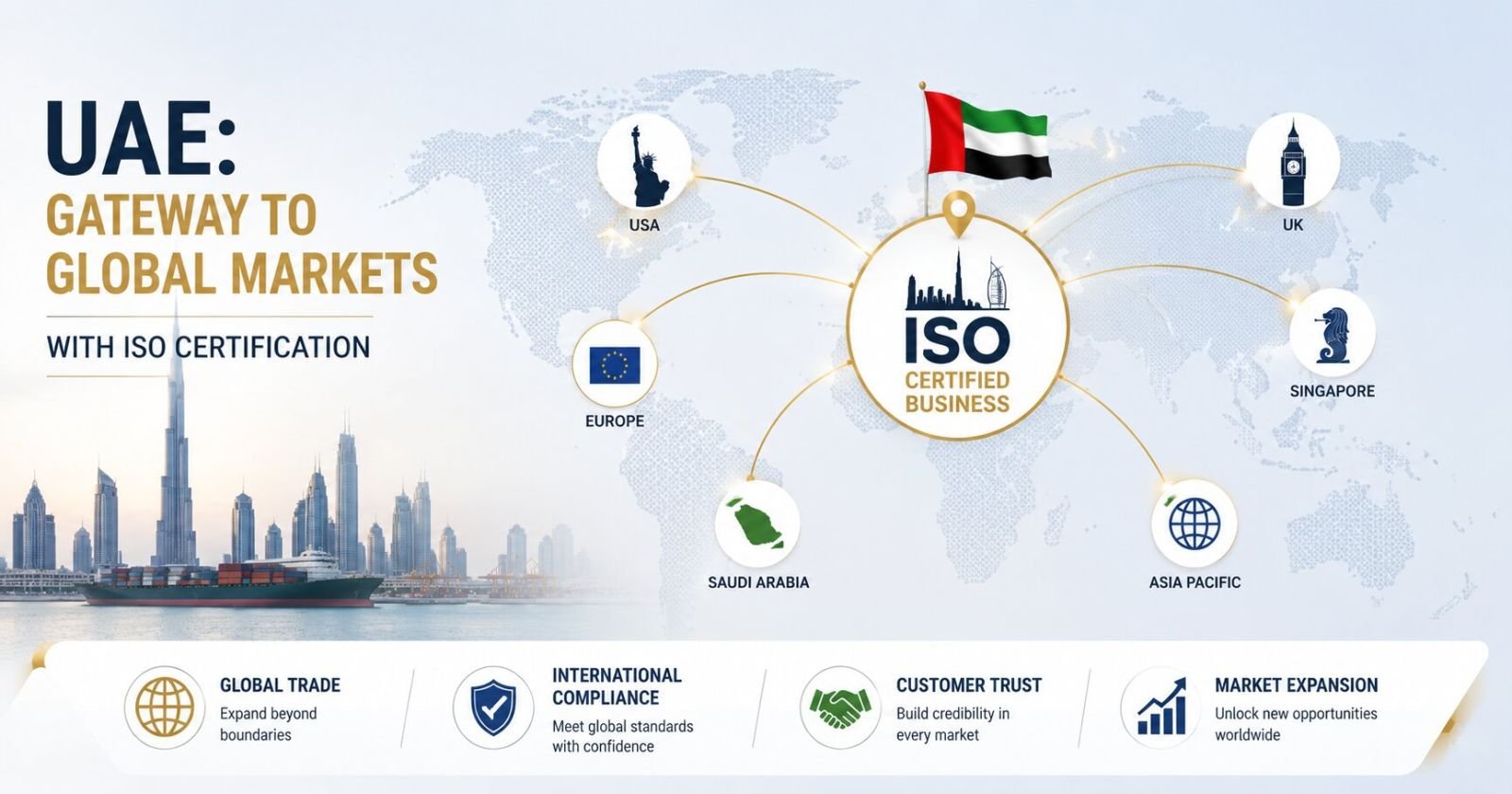
The UAE's role as the regional logistics and trade hub implies that a significant percentage of local businesses interact with international partners. And these business partners are increasingly utilizing ISO accreditation as a crucial credibility signal, not a distinguishing factor. It is a European or North American buyer evaluating a vendor based in UAE tends to narrow their choices the supplier based on whether they have an internationally recognized management system certification is in place, as it's a common basis regardless of their knowledge of the local market.
Free Zones Are Actively Encouraging Certification
The major free zones have begun promoting the use of certifications as a component of their business formation packages in recognition that certified tenants are more likely to get better clients and expand faster. This kind of institutional support, coupled with genuine competitive pressure, has pushed certification away from being the realm of a specialization to something closer to business hygiene standards.
Risk and insurance considerations are Making an appearance in the market.
Insurance companies in the UAE marketplace are now taking into account management system certification into their risk evaluations, especially in the fields of manufacturing and construction where failures to ensure safety and quality expose them to significant liability. A certified quality or safety management system provides insurers with the evidence needed to justify risk pricing. Some are now offering better conditions to applicants who have been certified as a result.
The Cost of Certification has fallen
The increasing competition among certification agencies and consultants in the UAE has brought down the price substantially compared to a decade earlier, making certification available for smaller and mid-sized businesses which previously thought it was only available to large corporates. The decrease in costs opens the door for a much wider range of companies looking to obtain certification for first time.
Different Standards Suit Different Businesses
Every business does not require the same certificate, and understanding which standard actually is the first hurdle. A construction firm's priorities around security management can be quite different than a software company's goals in terms of security for information. This is why demand has risen across a range of different standards rather that focusing on only one.
What does this mean for companies? Still on the Fence
For those who are still debating whether or not certification is worth it and what the real-world situation is in 2026 is that the focus has shifted from whether competitors have certification to how many possible opportunities are going unnoticed without it. Beginning by assessing the gap against the relevant standard, followed by a planned timeline for implementation before an external audit. The procedure is far easier than even five years ago.
The Talent Market Responds Too
As certification is becoming more crucial to how UAE companies operate, an actual local talent market is developing around quality environmental, and safety and roles. There are more professionals possessing lead auditors who are recognized and the certifications to implement than before. This has made it easy for companies to recruit internal employees that can manage an organization long into the future after certification process end, instead of using external consultants indefinitely.
Multinational Companies Set the Regional Tone
A lot of multinational corporations that operate through regional or Middle East headquarters out of the UAE bring their current global regulations for certification as well as requiring local suppliers and allies to meet the same requirements. This has resulted in a negative impact, as local businesses that are supplying to these supply chains with multinationals typically encounter certification requirements that descend from expectations for clients that originate somewhere outside the UAE within the country.
It is increasingly being viewed as a Growth Enabler, It's Not Only Compliance
Perhaps the most significant shift in mindset over the last few years is that more UAE businesses are now viewing certification as something that assists growth, by opening open tender eligibility and international partnership opportunities instead of simply an additional cost to maintain compliance. This shift in perspective has made the expenditure much more rational internally, as it links directly to revenue opportunity rather than sitting purely in the compliance budget.
What to Expect in the Coming Years To Come
Based on the current state of affairs, it seems reasonable to assume that ISO certification to remain a competitive advantage to a entrance requirement into many UAE industries over the next years. Companies that are able to anticipate this transition now instead of waiting until the certification is mandatory typically find the process significantly less stressful and the resulting strong competitive position.
How long the entire process Is Typically
The entire process beginning with the gap assessment and ending with certificate issuance usually takes between three and nine months based on the scale of business, current process maturity, and how quickly internal teams can be able to implement required adjustments. Businesses under genuine time pressure sometimes try to compress this process significantly, but rushing the implementation process can create a management system that has difficulty in the initial surveillance check, making a more realistic timeframe an investment worth it.
Ultimately, the surge in ISO certification in the UAE indicates a market has matured past treating health and safety as an internal choice and is now treating it as a fundamental requirement for doing business in a professional manner, locally and internationally. In the case of any business wishing to start, the best next procedure is to engage in a short, authentic conversation with a certification organization or a trusted consultant about which ISO standard will meet current requirements and expectations, not merely guessing from what a competitor appears to have on their website. None of this momentum shows signs of slowing down that makes the current situation a sensible one for companies who are still considering certifications to go from contemplation to an action. Take a look at the recommended ISO 27001 Certification for website info.

ISO 14001 Certification Why Iso 14001 Certification? Environmental Management Is Important For Uae Companies
Environmental issues have shifted from becoming a genuine business priority across the UAE with the help of sustainable development commitments at the national level and also due to increasing regulatory and client expectations. ISO 14001, the international standard for environmental management systems, is now an obvious choice for companies who want to display true, solid environmental responsibility in addition to good intentions alone.What ISO 14001 Actually Requires
The standard requires businesses to determine the environmental impacts of their operations, know their impact and put measures in place to control and reduce negative impacts in the course of time. It could be anything from controlling emissions and waste when working in a factory to cutting down on paper and energy use in an office-based service business, since the standard is applicable proportionally to any business's specific environmental footprint looks like.
Alignment with National Sustainability Goals
The wider national commitments of the UAE regarding sustainability and net zero targets has created an actual institutional momentum in the field of environmental management. ISO 14001 certification gives individual businesses an official way to prove their commitment to those larger objectives. This is increasingly important for firms that bid on government and semi-government procurements, where the environmental qualifications are now an transparent evaluation criteria.
Industries where it is most important.
Manufacturing, construction oil and gas and logistics tend to face the greatest environmental scrutiny given the sheer size of their operations. However, service-based firms are increasingly trying to get certification, too, for tender eligibility and genuine cost reductions through efficiency in resource usage. Even companies with small environmental footprint typically find the method of structure reveals undiscovered efficiency potential.
Legal Compliance Angle Legal Compliance Angle
An important aspect from ISO 14001 involves identifying and tracking compliance with applicable environmental legislation and rules and regulations. These requirements in the UAE environment spans federal environmental laws as well as emirate-specific regulations. Certified companies generally have a clearer, more current view of their compliance obligations than their non-certified counterparts, making it less likely for accidental violation and the resulting penalties.
Integration With Other Management Systems
Many UAE companies that want to pursue ISO 14001 already hold or are simultaneously pursuing ISO 9001, and the two standards have enough similarities in structure that an integrated system of management covering both standards is often more efficient when compared to treating them like separate projects. This integrated approach minimizes duplicated documentation and audit effort considerably for businesses that are managing multiple certifications.
What the Certification Process Looks Like
As with other management system standards Certification follows a defined sequence: a gap evaluation, implementation of necessary processes and documentation the internal review, and following that, an external two-stage audit completed by an accredited certification body. Surveillance audits on a regular basis, typically annually, assure that the management system is in good condition instead of reversing the process after the first certificate has been issued.
The real benefits of business go beyond the Certificate
Beyond tender eligibility and regulatory transparency, companies that have implemented ISO 14001 properly often uncover real savings in costs through improved waste and resource management, and also reputational benefits from increasingly eco-conscious clients as well as partners. These practical benefits are part of the reason why eco-certification has become more than a compliance-driven process for many UAE businesses.
How to Measure What Really Matters
An effective implementation of the ISO 14001 system focuses measurement efforts on environmental factors that matter most to the specific company, rather than tracking indicators solely because they're easy to measure. A logistics company might prioritise fuel consumption and route efficiency and efficiency, while a manufacturing firm might focus more heavily on water consumption and waste generation that reflect where each company's true environmental impact is.
Securing Contractors and Suppliers
Many UAE businesses find that a substantial portion of their overall environmental impact is attributable to contractors and suppliers as opposed to their own operations, and ISO 14001 encourages businesses to look at the wider supplier chain impact rather than thinking of environmental management as just an internal problem. It's led some ISO 14001-certified UAE organizations to ask their primary suppliers about sustainable practices. This has created an ensuing ripple effect in suppliers in the supply chains local to them.
Emergency Preparedness is Part of the Standard
ISO 14001 requires businesses to be aware of potential environmental emergencies related to their activities, such as chemical spills or equipment failures that can have environmental consequences, and have genuine evacuation plans in place, rather than tackling such emergencies in a reactive manner. This 'preparedness' element frequently reveals the gaps that businesses haven't taken into account, specifically around staff trained for emergency scenarios.
A Standard That Rewards Real Commitment
In the end, ISO 14001 rewards businesses who consider environmental management a genuine ongoing operational priority and not merely a documentation process which is only completed once and forgotten. UAE companies that integrate the standard's principles into daily process of decision-making, and not merely putting the standard within an individual compliance function tend to experience the most beneficial environmental and brand reputation benefits over time.
The management of water is an issue that deserves particular attention in the UAE in the UAE context
In light of the climate that is arid in the United Arab Emirates and reliance on desalinated water in its use and management, water consumption is often a priority within an ISO 14001 system compared with areas where water scarcity is less of a concern. Companies that incorporate water efficiency into their environmental control system right from the start tend to find this among the most beneficial aspects of ISO 14001 certification in the local situation.
For UAE businesses weighing up ISO 14001, the certification provides both a solution to the genuine pressures from regulatory and market pressures as well as a chance to manage environmental impact more effectively, which affects regulators, customers as well as the UAE's own national sustainability goals. As environmental demands across the UAE are rising, businesses that build genuine environmental management capabilities today, instead of waiting for it to become a mandatory requirement, will succeed in the future. The whole process shouldn't cause anxiety for small companies as the scales of standardization significantly, and even a modest green initiatives that are implemented frequently are likely to be accepted by auditors much superior to a grand plan that never follows through. Consistency, rather than goals alone, is the only thing that auditors and real environmental outcomes both reward. Small and sustained changes are more likely over ambitious goals that are stalled after a few months. Have a look at the recommended ISO Certification Services for site tips.